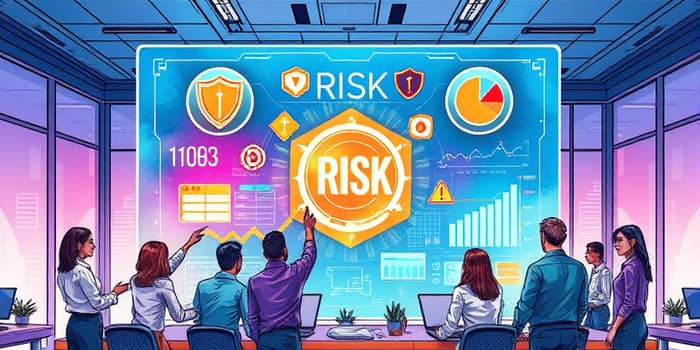
In today's fast-paced business world, uncertainty lurks around every corner, threatening to derail success and stability.
Key Risk Indicators (KRIs) serve as quantifiable metrics that empower organizations to navigate this chaos with confidence and foresight.
By providing early warning signals, they transform risk from a hidden threat into a manageable asset, ensuring resilience and growth.
Understanding Key Risk Indicators
KRIs are not just numbers on a spreadsheet; they are predictive tools designed to measure the likelihood and impact of adverse events.
They focus on forward-looking insights, allowing businesses to anticipate problems before they escalate.
This contrasts with traditional metrics that often look backward, missing critical opportunities for intervention.
Effective KRIs are characterized by their ability to track trends and align with industry standards.
- They must be measurable, such as using percentages or dollar amounts.
- High relevance and correlation to specific risks are essential for accuracy.
- Sensitivity to changes ensures timely alerts for proactive measures.
By drilling down to root causes, KRIs help organizations understand not just what is happening, but why.
KRIs vs. KPIs: A Crucial Distinction
Many confuse KRIs with Key Performance Indicators (KPIs), but they serve different purposes in strategic management.
KPIs measure past and current performance against goals, like sales or revenue achievements.
In contrast, KRIs are predictive in nature, focusing on potential threats that could hinder objectives.
This distinction is vital for allocating resources effectively and avoiding costly surprises.
The Power of KRIs in Enterprise Risk Management
Integrating KRIs into Enterprise Risk Management (ERM) programs enhances proactive action and organizational agility.
Without them, companies risk unmitigated events that can damage operations, finances, or reputation.
Benefits include early warnings for real-time intelligence and backward views for lessons learned.
- KRIs help prioritize risks, ensuring resources are focused where they are needed most.
- They enhance executive engagement by providing clear, actionable insights.
- Post-SEC 2010 rulings have escalated their importance for validating strategic risks.
By monitoring changes in risk profiles, KRIs offer a continuous feedback loop for improvement.
Building Your KRI Framework: A Step-by-Step Guide
Creating effective KRIs requires a structured approach to ensure they are meaningful and actionable.
Start by defining your business objectives and identifying key risks that could impact them.
Connect these risks to objectives to understand their potential consequences on success.
- Define objectives: Identify key business attributes and KRI goals.
- Identify risks: List financial, operational, compliance, and cybersecurity risks.
- Connect risks and objectives: Map impacts to ensure relevance.
- Rank risks: Prioritize by importance to organizational goals.
- Define KRIs: Develop metrics for materializing risks, such as thresholds.
Additional best practices include ensuring root-cause focus and easy measurement for efficiency.
Set thresholds to define unacceptable levels that trigger response actions, like alerts or reviews.
Challenges like inaccurate data or lack of management support must be addressed for success.
Categories and Real-World Examples
KRIs span various business areas, from financial to human elements, providing comprehensive coverage.
In financial contexts, they might track budget changes or economic conditions for stability.
Operational KRIs focus on operational inefficiencies, such as process gaps or quality issues.
- Financial: Sales growth targets, regulatory shifts, or merger risks.
- Operational: Control gaps, production vs. demand mismatches, leadership changes.
- Strategic: Changes to goals or supplier failures that could derail plans.
- Human/Reputational: Employee retention rates or customer churn indicators.
- Technology/Cybersecurity: System availability or cybersecurity threats like patch delays.
Specific examples help illustrate how KRIs work in practice, such as a 15% month-over-month increase in employee complaints.
This can signal deeper issues like morale problems or management flaws requiring intervention.
Setting Thresholds and Measuring Success
KRIs clarify risk appetite, the acceptable level of risk for achieving goals, versus tolerance, the deviation allowance.
Use risk scoring to quantify and prioritize risks based on likelihood, severity, and impact.
Metrics should be drawn from reliable sources like financial reports or incident data.
Establish processes for data collection and comparison to ensure accuracy over time.
- For employee satisfaction, a threshold might be a 15% increase in complaints.
- In cybersecurity, being two patches behind schedule could trigger immediate action.
- Regular monitoring ensures KRIs remain aligned with evolving business needs.
This approach transforms abstract risks into concrete, manageable metrics.
Looking Ahead: The Future of KRIs
As risk landscapes evolve, KRIs must become more dynamic to address emerging challenges like digital transformation.
Integration with other tools, such as loss events and assessments, provides deeper control insights.
Qualities for success include being actionable, precise, and having confidence levels for decision-making.
Real-world contexts, like supplier fraud examples, show how KRIs can mitigate crises effectively.
By 2026, dynamic risk landscapes will demand KRIs that go beyond static protocols for agility.
Tools and enhancements, including AI for workflows, will streamline KRI implementation and analysis.
This future orientation ensures organizations stay ahead of threats and seize opportunities.
Conclusion: Empowering Your Organization
KRIs are not just a compliance tool; they are a strategic asset that drives resilience and innovation.
By measuring what truly matters, businesses can turn uncertainty into a competitive advantage.
Start today by defining your first KRI and watch as it transforms your approach to risk management.
Embrace the journey towards a more proactive and empowered organizational culture.
References
- https://www.techtarget.com/searchcio/definition/key-risk-indicator-KRI
- https://en.wikipedia.org/wiki/Key_risk_indicator
- https://www.metricstream.com/insights/Key-Risk-indicators-ERM.htm
- https://riskonnect.com/enterprise-risk-management/what-is-a-key-risk-indicator-and-why-is-it-important/
- https://legal.thomsonreuters.com/blog/key-risk-indicators-kris-an-overview/
- https://www.bitsight.com/blog/key-risk-indicators
- https://www.logicmanager.com/resources/erm/risk-metrics-for-governance-effectiveness/
- https://bernardmarr.com/the-difference-between-a-kpi-and-kri/
- https://safetyculture.com/topics/key-risk-indicators