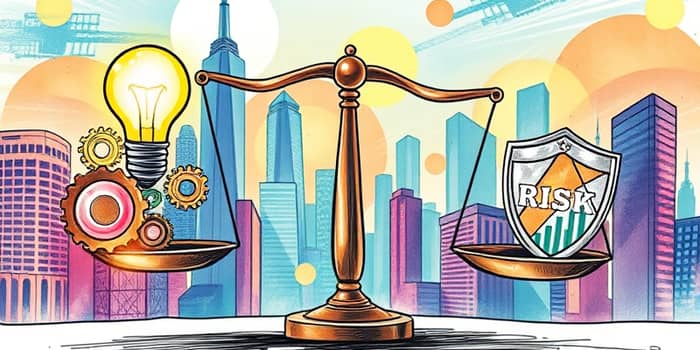
In today's fast-paced markets, the interplay between bold new ideas and cautious planning defines organizational futures.
Embracing innovation can lead to **transformational growth and market leadership**, but neglecting risk management invites costly failures.
This delicate balance is **the cornerstone of sustainable development and long-term viability** for all businesses.
From startups to global corporations, finding this equilibrium drives competitiveness and resilience.
It allows companies to seize opportunities while safeguarding their core assets.
The Imperative of Innovation and Risk
Innovation is the engine of progress, pushing boundaries to meet evolving customer needs.
Studies show that firms prioritizing innovation are **2.5 times more likely to outperform competitors** in revenue and growth.
Yet, unchecked innovation can spiral into disasters, like financial losses or reputational damage.
Risk management provides a safety net, enabling calculated moves rather than reckless gambles.
Together, they form a symbiotic relationship that fuels sustainable advancement.
Common Challenges in the Balancing Act
Businesses often stumble when trying to harmonize risk and innovation.
Key obstacles include overinvestment in unproven ideas and security vulnerabilities from digital shifts.
- Overinvestment drains resources without proper assessment.
- Cybersecurity threats emerge from rapid technological adoption.
- Market uncertainty makes it hard to predict customer acceptance.
- Cultural resistance, such as risk-averse finance teams clashing with innovators.
- Scalability issues arise when growth outpaces infrastructure.
These challenges can stall progress if not addressed proactively.
Leaders must navigate these waters with foresight and agility.
Strategic Frameworks for Effective Balance
Adopting structured approaches helps mitigate risks while fostering creativity.
One effective method is the use of **risk assessment frameworks to identify and prioritize threats**.
Controlled experimentation, like pilot programs, allows for learning without major setbacks.
- Risk assessment involves analyzing impact and probability.
- Mitigation strategies include diversification and contingency plans.
- Defining a clear **risk appetite aligns decisions with organizational goals**.
- Agile methods enable iterative development and quick adjustments.
- Technology tools, such as data analytics, support informed choices.
These tactics create a robust foundation for innovation to thrive.
This table summarizes key approaches to harmonizing risk and innovation.
Cultural and Leadership Shifts
Fostering the right mindset is crucial for long-term success.
Leaders should encourage **a risk-aware culture that rewards calculated experiments**.
Open communication channels allow teams to voice concerns and share ideas freely.
- Embed risk management across all departments.
- Create dedicated innovation units to isolate risks.
- Promote collaboration between diverse teams.
- Use feedback loops to refine processes continuously.
These efforts build resilience and adaptability within organizations.
They empower employees to contribute without fear of failure.
Real-World Success Stories
Case studies illustrate how balance drives tangible outcomes.
Johnson & Johnson used a structured framework for its COVID-19 vaccine development.
They assessed clinical and market risks, enabling **rapid innovation with ensured safety and efficacy**.
Small businesses, like cafes, align innovations such as delivery apps with core visions.
This prevents operational misalignment and preserves brand integrity.
- Large firms establish venture-style units to manage high-risk projects.
- Boards utilize risk appetite statements for tech-driven industries.
- Cross-functional teams enhance coordination and efficiency.
These examples highlight practical applications of the principles discussed.
Metrics and KPIs for Measurement
Tracking progress is essential to refine strategies over time.
Key performance indicators help gauge the effectiveness of risk-innovation balance.
Innovation success rate measures **the percentage of projects meeting objectives**.
Risk mitigation efficiency assesses how well losses are minimized.
- Time-to-market: Speed from idea to launch.
- ROI analysis: Value delivery per project.
- Portfolio balance: Mix across core, adjacent, and transformational.
- Employee engagement in innovation initiatives.
- Customer feedback on new offerings.
These metrics provide insights for continuous improvement.
They enable businesses to adjust course based on real data.
Broader Context and Implications
The balance between risk and innovation extends across industries and scales.
In healthcare, it ensures patient safety while advancing treatments.
For tech companies, it drives product development amidst rapid change.
This approach fosters **sustainable growth and a competitive edge in disruption**.
Ultimately, mastering this balance leads to long-term agility and success.
By embracing experimentation and collaboration, organizations can future-proof themselves.
They turn potential pitfalls into pathways for achievement.
References
- https://www.advanceit.sg/blog/balance-innovation-with-risk-management-for-business-owners
- https://stellarlibrary.com/2024/11/building-a-balanced-approach-to-risk-and-innovation/
- https://mdconsultingglobal.com/balancing-innovation-and-risk-management/
- https://www.quikstonecapital.com/merchant-cash-advance-blog/balancing-innovation-with-risk-management-in-your-small-business
- https://ecampusontario.pressbooks.pub/leadinginnovation/chapter/chapter-9-innovation-risks/
- https://www.barclaysimpson.com/risk-versus-innovation-do-you-have-the-right-balance/
- https://vorecol.com/blogs/blog-how-can-companies-effectively-balance-risk-and-innovation-to-stay-competitive-in-a-rapidly-changing-market-153823
- https://www.teknita.com/balancing-innovation-and-risk-a-cios-guide/