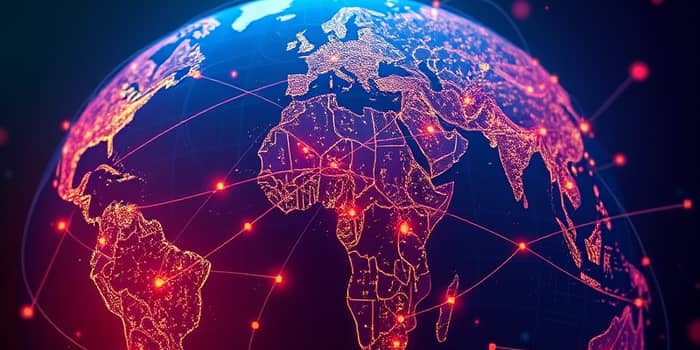
Globalization has woven our world into an intricate tapestry where every thread, from trade routes to data streams, holds the potential to unravel stability or foster unprecedented growth.
Despite rising tariffs, geopolitical tensions, and economic slowdowns, metrics like the DHL Global Connectedness Index reveal that globalization remains at record highs, with trade depth hovering around 25% of GDP, a near-peak level that underscores the enduring power of international exchange.
This reality exposes economies, businesses, and supply chains to a cascade of interconnected risks, where events in one region can ripple across continents, demanding a proactive and informed approach to risk management in an era defined by fragile but persistent connectivity.
The Unyielding March of Globalization
Contrary to narratives of retreat, the world is not shifting toward isolationism or regional blocs.
Globalization, as measured by flows of trade, information, capital, and people, has maintained robust levels, with information flows being the most globalized due to digital advancements.
This persistence highlights that borders and distance, while constraining, have not halted the deep integration that drives modern economies.
Key indicators show that partial globalization is the norm, with approximately 80% of economic activity domestic, yet the remaining cross-border portion carries disproportionate weight in shaping global dynamics.
- Trade depth held steady at 21% in 2024, close to the 22% record from 2008, indicating resilient international engagement despite headwinds.
- Capital and trade flows, though less globalized than information, continue to influence investment decisions and market trends on a worldwide scale.
- People movement rebounded to record highs in 2024 post-COVID, though it remains the least globalized aspect, reflecting recovery in travel and migration patterns.
These trends affirm that disengagement is not a viable strategy; instead, embracing interconnectedness with caution is essential for navigating the complexities of our time.
Navigating the Numbers: Key Forecasts and Trends
To grasp the risks, one must first examine the economic forecasts that paint a picture of cautious growth and resilient trade patterns.
Global GDP growth is projected to slow to 2.7% in 2026, down from pre-pandemic averages, signaling a fragile but persistent expansion largely driven by emerging markets.
Trade growth, however, demonstrates surprising vitality, with a 3.2% increase in 2025, the fastest in over a decade excluding pandemic anomalies, buoyed by robust U.S. participation.
- Regional GDP projections vary widely, with South Asia leading at 5.6% growth in 2026, while Japan lags at 0.9%, showcasing uneven economic fortunes across the globe.
- Goods trade patterns reveal a shift toward longer distances, with the average trade route now nearly 5,000 kilometers, the longest on record, challenging assumptions about regionalization.
- Intra-regional trade share has declined to a record low of 50.7%, further emphasizing that globalization is not retreating but evolving in complex ways.
Investment signals are mixed, with greenfield foreign direct investment exceeding past decade averages, yet mergers and acquisitions show stable regionalization, indicating no broad shift toward domestic focus.
Travel recovery has been robust, with international arrivals surpassing 2019 levels since October 2024, though regions like Asia-Pacific still lag, highlighting disparities in post-pandemic rebound.
The Web of Risks: Geopolitical and Economic Drivers
Beneath these optimistic numbers lies a thicket of risks that can disrupt global equilibrium at any moment, demanding vigilance and strategic planning.
Geopolitical rivalries, particularly the U.S.-China tension, are reshaping sourcing and logistics, leading to exposed shipping lanes and soaring freight rates up 150% late 2024 versus pre-pandemic levels.
Energy and commodities markets are tight, with electricity constraints emerging due to the AI infrastructure boom, data centers, and electric vehicles, forcing industries to seek stable power sources elsewhere.
- The AI infrastructure boom drives trade in power and warehousing but increases power demand by 17% to 2026, straining resources and input prices for small and medium enterprises.
- Financing volatility persists, with foreign exchange fluctuations and varying regional costs creating hurdles for securing materials amid rising prices, emphasizing the need for liquidity management.
- Investment remains subdued due to geopolitical uncertainties and tight fiscal policies, though AI fuels pockets of growth that risk widening inequality and social divides.
Inequality is a pervasive issue, with global finance favoring rich countries, leading to an annual flow of about 1% of GDP from poor to rich nations, exacerbating economic disparities.
These drivers necessitate proactive strategies to mitigate exposure and build resilience in an interconnected world where risks are amplified by digital and physical linkages.
A Regional Lens: Vulnerabilities Across the Globe
Risks are not distributed evenly; each region faces unique challenges and opportunities that require tailored responses and localized insights for effective risk management.
This table highlights how regions like Africa and South Asia, with higher growth forecasts, still grapple with vulnerabilities such as debt and climate shocks, while Europe contends with energy bottlenecks that could stifle innovation.
Understanding these nuances is key to developing effective risk management plans that account for regional specificities and global interdependencies.
Building Resilience in an Interconnected Era
In the face of these exposures, building resilience is not just an option but a necessity for survival, growth, and sustainable development in a hyper-connected world.
The themes for 2026 emphasize a shift toward national security over efficiency, with AI and energy transformations reshaping trade landscapes and creating new risk vectors.
To thrive, businesses and policymakers must adopt a multifaceted approach that balances engagement with caution, leveraging data and collaboration to navigate uncertainties.
- Diversify supply chains strategically to reduce dependency on single regions or routes, exploring new markets as trade distances increase globally.
- Invest in energy-efficient technologies and stable power sources to mitigate the impacts of the AI-driven power demand surge and ensure operational continuity.
- Monitor geopolitical developments closely, using tools like connectivity indices to anticipate shifts in trade and investment flows and adjust strategies accordingly.
- Foster regional collaborations where possible, as seen in East Asia's increased regionalization, to build buffers against global disruptions and enhance collective security.
- Address inequality by supporting inclusive growth initiatives, ensuring that the benefits of globalization and AI are shared more equitably to reduce social tensions.
Moreover, the concept of partial globalization, where only a fraction of activity is international, offers opportunities for strategic engagement without overexposure, allowing stakeholders to tap into global networks while maintaining local stability.
By embracing this reality, we can navigate interconnected risks with confidence and agility, turning vulnerabilities into strengths through innovation and cooperation.
The path ahead is one of resilient but fragile growth, where uneven AI benefits risk widening gaps, but with proactive measures, a more stable and equitable future is achievable for all participants in the global economy.
As data shows, flows over longer distances and the absence of a domestic shift suggest that globalization, in its current form, is enduring, and learning to live with its risks is the new imperative for success.
In conclusion, the interconnected world presents a daunting array of exposures, from trade disruptions to energy shortages, but it also offers unparalleled opportunities for those who are prepared to adapt and innovate.
By understanding the metrics, anticipating the risks, and building regional and sectoral resilience, we can foster a more sustainable global economy that thrives on connectivity while mitigating its perils, inspiring hope and action in an era of complex challenges.
References
- https://www.dhl.com/global-en/microsites/core/global-connectedness/tracker.html
- https://incomlend.com/blog-post/10-trends-transforming-global-trade-in-2026
- https://desapublications.un.org/publications/world-economic-situation-and-prospects-2026
- https://www.bcg.com/publications/2025/geopolitical-forces-shaping-business-in-2026
- https://www.woodmac.com/blogs/the-edge/five-themes-shaping-the-energy-world-2026/
- https://www.oecd.org/en/about/news/press-releases/2025/12/global-economy-proves-resilient-but-remains-fragile.html
- https://wid.world/news-article/world-inequality-report-2026-inequality-persist-at-a-very-extreme-level/