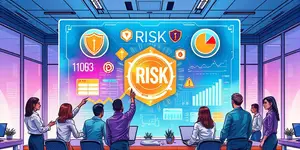
In today's rapidly evolving business landscape, independent risk oversight stands as a critical shield against uncertainty and disruption.
This approach involves external or unbiased evaluations that provide objective insights into vulnerabilities often overlooked by internal teams.
By focusing on inherent and residual risks, organizations can better anticipate and mitigate potential threats, enhancing their resilience.
Why Independent Oversight is Essential
In complex environments, internal processes may fall short due to biases or blind spots.
Independent oversight offers a fresh perspective, ensuring that risks are identified and addressed with clarity and precision.
It transforms risk management from a reactive task into a proactive strategy for growth and stability.
This is not just about compliance; it's about building a culture of awareness and preparedness.
The Core Benefits of Independent Risk Oversight
The advantages of independent oversight are substantial and measurable.
It leads to objective identification of risks, reducing the impact of groupthink and internal bias.
Financially, it can result in significant cost savings, such as preventing penalties or reducing breach costs.
Other key benefits include enhanced efficiency, better compliance adherence, and protection of organizational reputation.
Strategically, it enables informed decision-making and supports long-term planning through scenario analysis.
- Reduces blind spots by uncovering hidden vulnerabilities.
- Prevents financial losses through proactive mitigation measures.
- Improves operational efficiency and regulatory compliance.
- Strengthens stakeholder trust and brand reputation.
- Enables better risk-reward assessments for strategic initiatives.
These benefits collectively foster a more resilient and agile organization.
Structures for Effective Risk Oversight
Implementing independent oversight requires clear frameworks and roles.
The Three Lines of Defense (3LOD) model is a widely adopted framework that defines responsibilities across different levels of an organization.
This model ensures a synergistic approach where risks are escalated appropriately without duplication.
Key roles, such as the Chief Risk Officer (CRO), play a vital part in coordinating these efforts.
- CROs report to top leadership with board access for unbiased insights.
- They influence compensation to align behaviors with risk objectives.
- Their focus is on strategic risk monitoring rather than mere compliance.
Board-level committees further strengthen oversight by setting risk philosophy and appetite.
Tools and Processes for Implementation
To operationalize independent oversight, organizations leverage various tools and methodologies.
Risk assessments range from questionnaires to comprehensive audits, providing continuous monitoring of threats.
Metrics like key risk indicators (KRIs) and earnings variance help quantify risks and track improvements.
Automated platforms, such as risk scoring systems, enhance efficiency and provide real-time insights.
- Use risk registers to document assets and controls for better visibility.
- Implement scenario modeling for forward-looking risk analysis.
- Adopt feedback loops to learn from past incidents and refine strategies.
These tools enable organizations to move beyond static reports to dynamic risk management.
Statistics and Trends in Risk Oversight
Current data highlights the growing importance of independent oversight.
For instance, 36% of organizations are increasing their investment in risk and compliance programs.
Costs related to insider risks have risen by 40% over four years, emphasizing the need for vigilance.
Adoption rates show that 74% of companies have incident response plans, with testing saving millions per breach.
- 63% of executives view their risk programs as effective, yet many remain immature.
- 49% of organizations have dedicated board-level oversight committees.
- Automation can reduce compliance costs by up to 10%, showcasing efficiency gains.
These statistics underscore the tangible value of proactive risk management.
Challenges and How to Overcome Them
Despite its benefits, independent oversight faces several hurdles.
Internal biases can lead to overlooked risks, while immature processes may hinder effectiveness.
Resource constraints, especially in positioning CROs, can limit implementation in established firms.
To address these, organizations should foster a culture of transparency and continuous learning.
- Encourage cross-functional collaboration to mitigate bias.
- Invest in training and tools to mature risk processes.
- Ensure adequate resourcing for independent roles to maintain objectivity.
By tackling these challenges, companies can unlock the full potential of risk oversight.
Real-World Case Studies
Examples from various industries illustrate the impact of independent oversight.
In a financial firm recovery, a CRO developed risk appetite statements and cyber models, leading to better board metrics.
Project teams with embedded independent evaluators have achieved planning efficiencies and cost savings.
Platforms that automate risk scoring have enabled organizations to track mitigation efforts more effectively.
These cases demonstrate how independent oversight can drive tangible improvements and strategic advantages.
The Future of Independent Risk Oversight
Looking ahead, the role of independent oversight is set to expand further.
Rising investments in insider risk programs and evolving enterprise risk management (ERM) practices signal a shift towards more integrated approaches.
Forward-looking models will replace reliance on outdated claims, enhancing predictive capabilities.
As economic pressures increase, the need for robust oversight will become even more critical.
By embracing these trends, organizations can build resilience and thrive in an uncertain world.
Independent risk oversight is not just a defensive measure; it's a catalyst for innovation and growth.
References
- https://www.c1risk.com/blog/the-value-of-an-independent-risk-assessment
- https://www.oranaskillscentre.com/post/the-importance-of-independent-risk-professionals-in-project-management
- https://www.scirp.org/journal/paperinformation?paperid=137600
- https://procurementtactics.com/risk-management-statistics/
- https://www.prosightfa.org/insights/the-triumvirate-of-risk-oversight-aligning-the-risk-chair-regulator-and-cro/
- https://www.corporatecomplianceinsights.com/positioning-independent-risk-management-succeed/
- https://corpgov.law.harvard.edu/2022/12/13/risk-oversight-and-the-board-navigating-the-evolving-terrain/
- https://www.chapman.com/publication-Separate-Risk-Committees
- https://www.spglobal.com/sustainable1/en/csa/insights/risk-management
- https://www.pwc.com/us/en/services/governance-insights-center/library/risk-oversight-boards-navigating-complex-evolving-area.html
- https://corpgov.law.harvard.edu/2019/11/20/risk-management-and-the-board-of-directors-7/
- https://www.mercer.com/insights/people-strategy/people-risks-and-business-resilience/people-risk-management/
- https://www.logicmanager.com/resources/erm/what-is-the-three-lines-of-defense-approach-to-risk-management/